Capture what your team knows, before it walks out the door.
Tinu captures the decisions, rationale, and context already flowing through the tools your team uses. It structures all of it into records your whole organization can pull up when someone hands off work, changes roles, or retires.
Connects to Slack, email, meetings, docs, and tickets. No one has to change how they work.
Decision
Move off Northwind for Q2 outbound freight.
Rationale
Two missed SLAs in eight weeks; the penalty clause triggered twice.
Alternatives weighed
Owner · recorded
ops@ · 2026-02-11
Switched after two missed SLAs. Weighed Cargominde and Railnet on cost and capacity, then chose on capacity. Source thread cited.
What institutional memory looks like in practice
Tinu turns the work your team already does into structured, searchable memory. Nobody has to sit down and write a wiki.
Move off Northwind for Q2 outbound freight
Two missed SLAs in eight weeks triggered the penalty clause twice. Weighed Cargominde and Railnet; chose Railnet on capacity.
Standardize incident severities on a 4-tier scale
Replaced ad-hoc P0/P1 usage so on-call and reliability reviews line up across all sites.
Adopt 12-month retention for raw sensor logs
Balances audit requirements against storage cost; older data rolls to cold archive automatically.
Every important call becomes a decision record: what was decided, the reasoning, the alternatives that were weighed, and who to ask. Each one is scored for how complete it is.
Captured from the tools you already use
Tinu reads from Slack, email, meetings, docs, and tickets in the background and drafts a decision record on its own. No new habits, no blank pages to fill.
Decision
Move off Northwind for Q2 outbound freight.
Captured from
#ops-logistics thread (14 messages) + RFP_final_v3.xlsx
Know what is actually complete
Tinu scores every record two ways, a strict schema check and a qualitative review, so it knows exactly what is missing. Then it asks the one person who can fill the gap, in a short prompt.
One gap left: which vendor did you weigh Cargominde against on cost? Reply here and I’ll finish the record.
Answers in Slack, cited to the source
Ask @tinu and get an answer grounded in real decision records. Every claim links back to the original thread or document, and stays scoped to what each person is allowed to see.
Northwind missed two delivery SLAs in eight weeks, triggering the penalty clause twice. The team weighed Cargominde (cost) and Railnet (capacity), and chose Railnet on capacity.
Built for the work your industry actually does
Pick your world and see Tinu in your language. Each demo is a real, populated workspace you can open in one click.
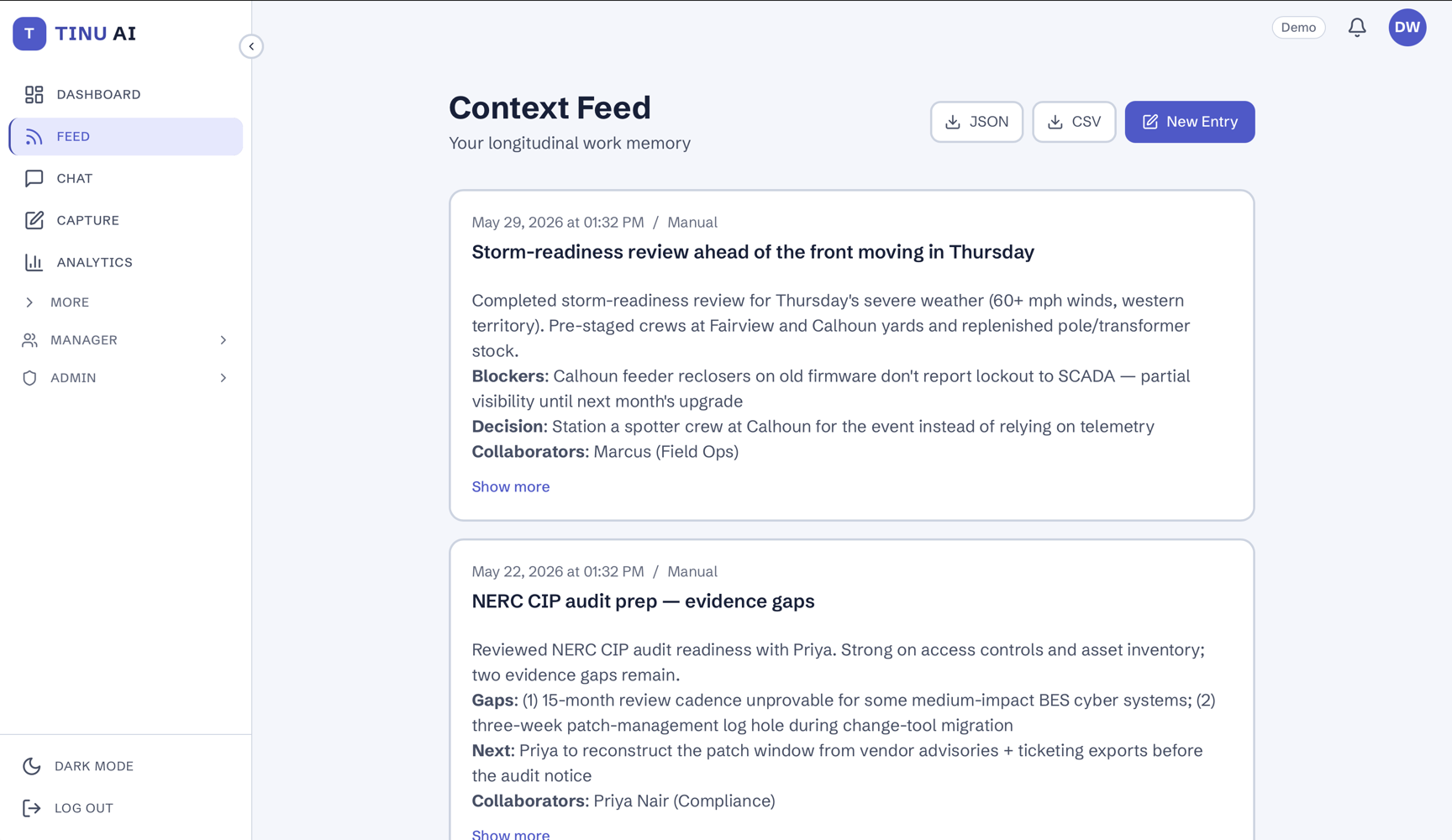
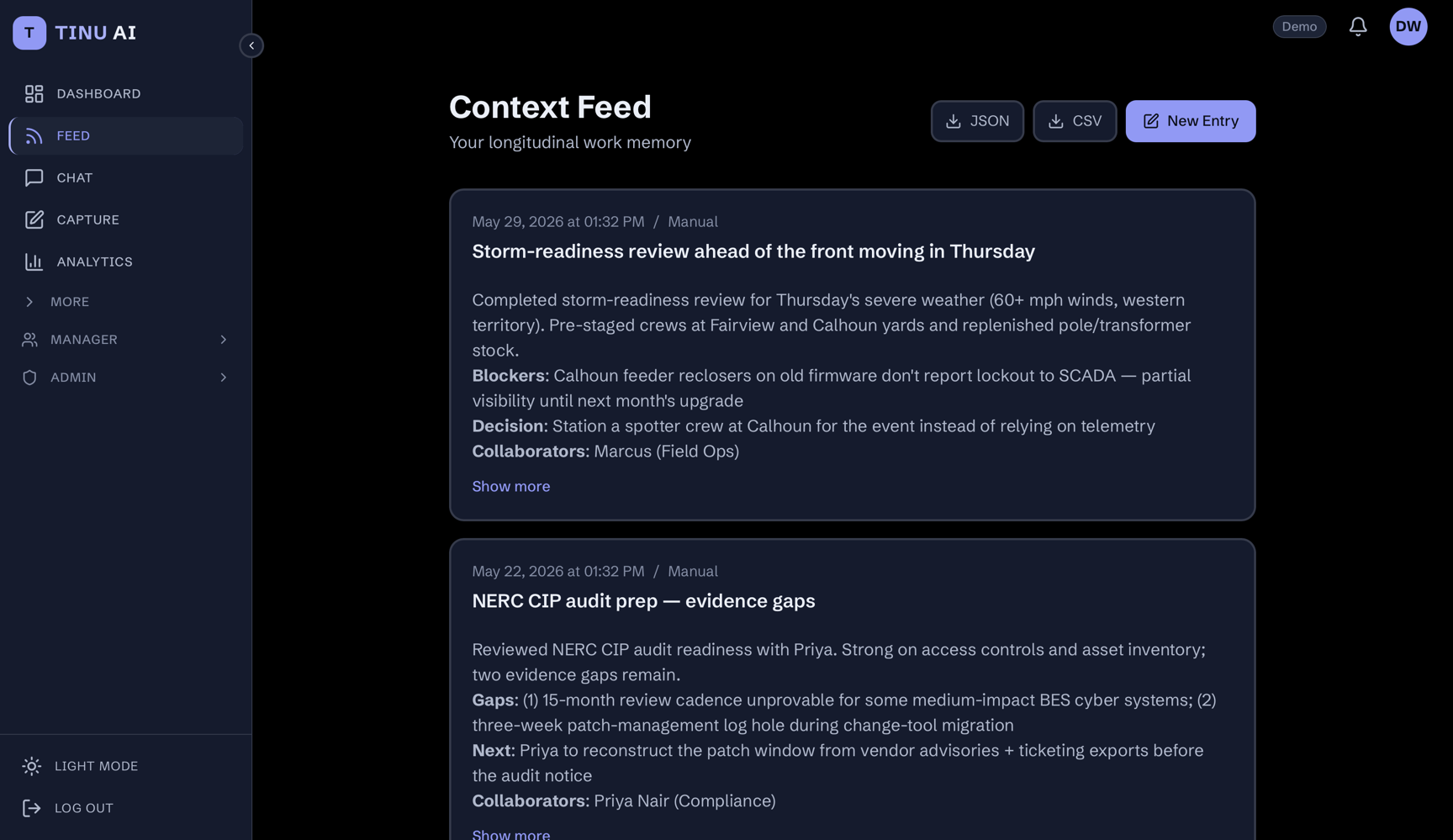
Storm-ready operations and audit-ready compliance, without the blind spots.
- SAIDI down 8% year-over-year across the territory, as the vegetation-management program hit its stride.
- When the Calhoun feeder reclosers went blind to SCADA, Tinu surfaced the decision to station a spotter crew, who radioed in two lockouts within minutes.
- NERC CIP prep: a 15-month review cadence and a 3-week patch-log gap reconstructed from vendor advisories before the audit notice landed.
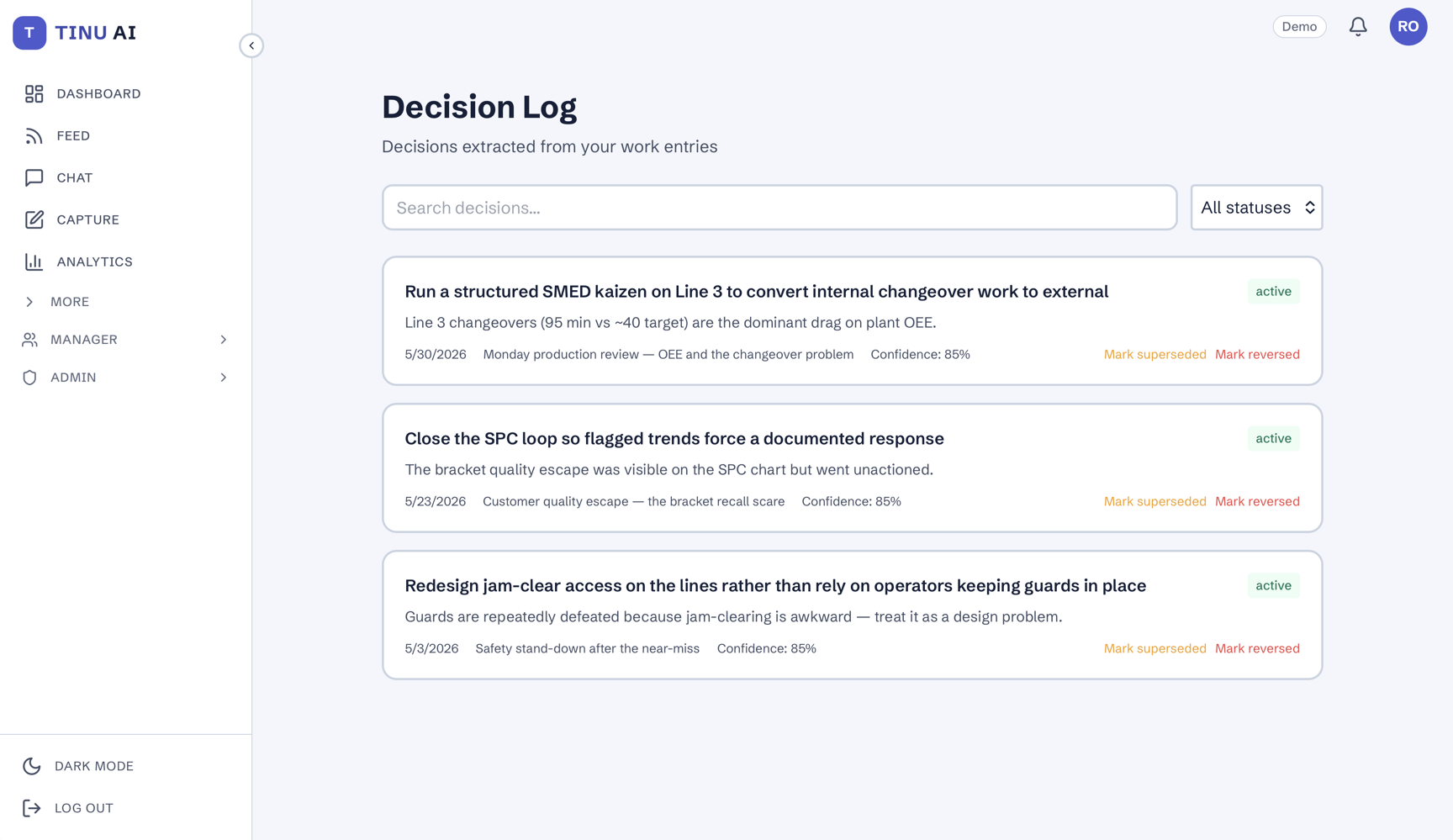
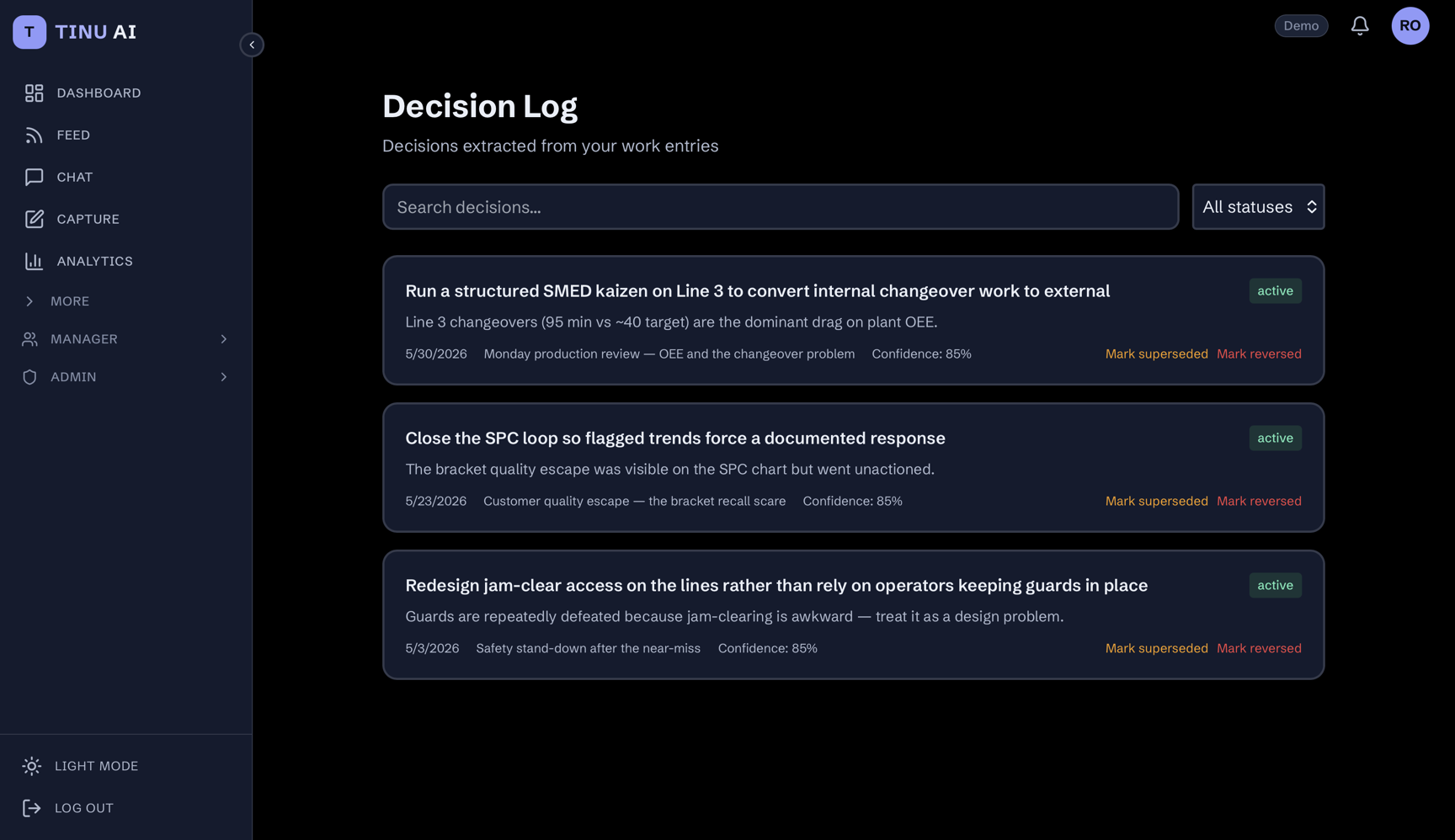
Turn the signals you already have into the changeovers and quality you’re missing.
- Line 3 changeover cut from 95 to 62 minutes with a structured SMED kaizen, and tracking toward a sub-40 target.
- Plant OEE at 71% against a 78% target, with Line 3 changeovers pinpointed as the dominant availability drag.
- A bracket quality escape the SPC chart had already predicted, now caught early by Western Electric run rules and wear-based tool changes.
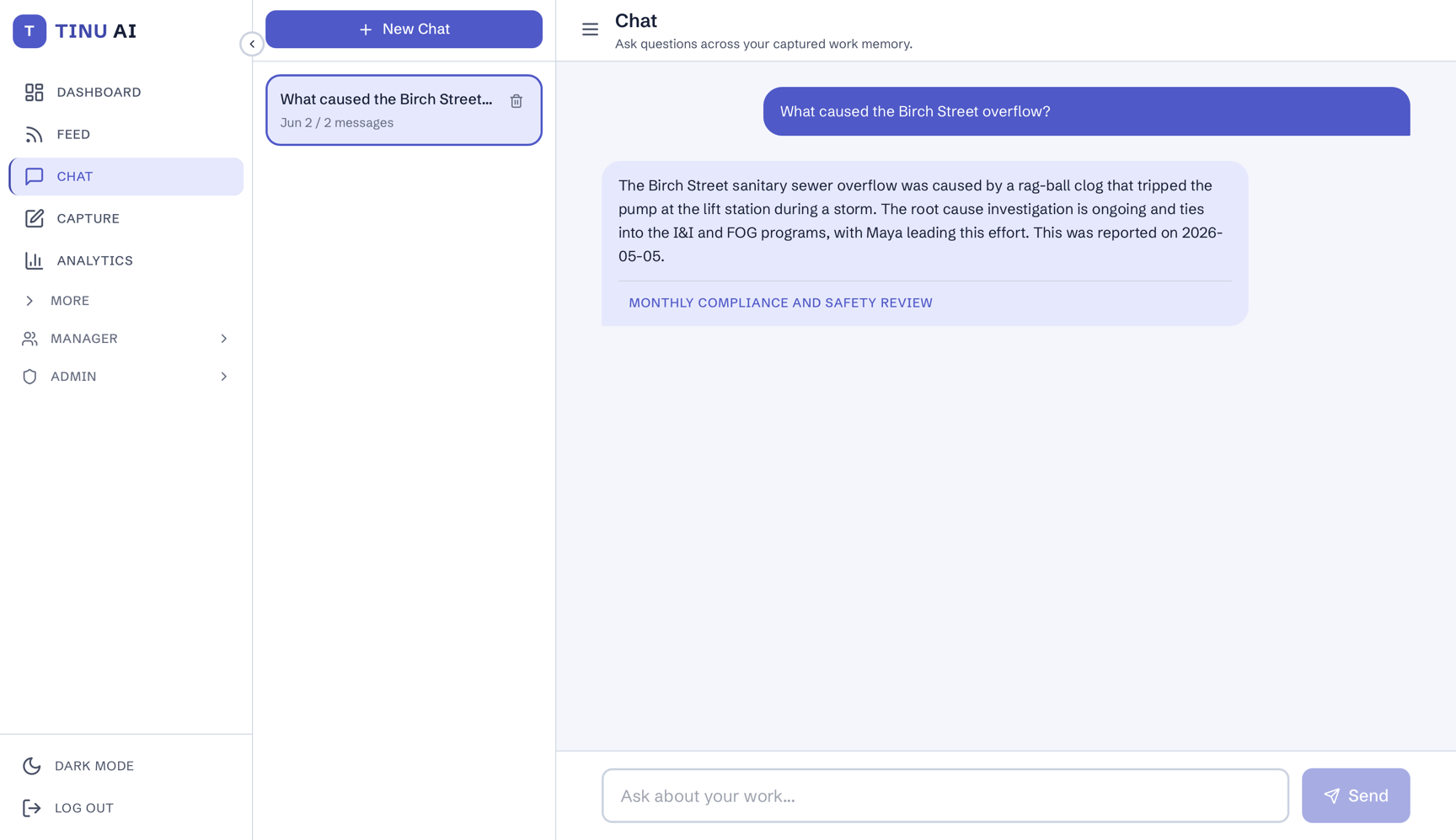
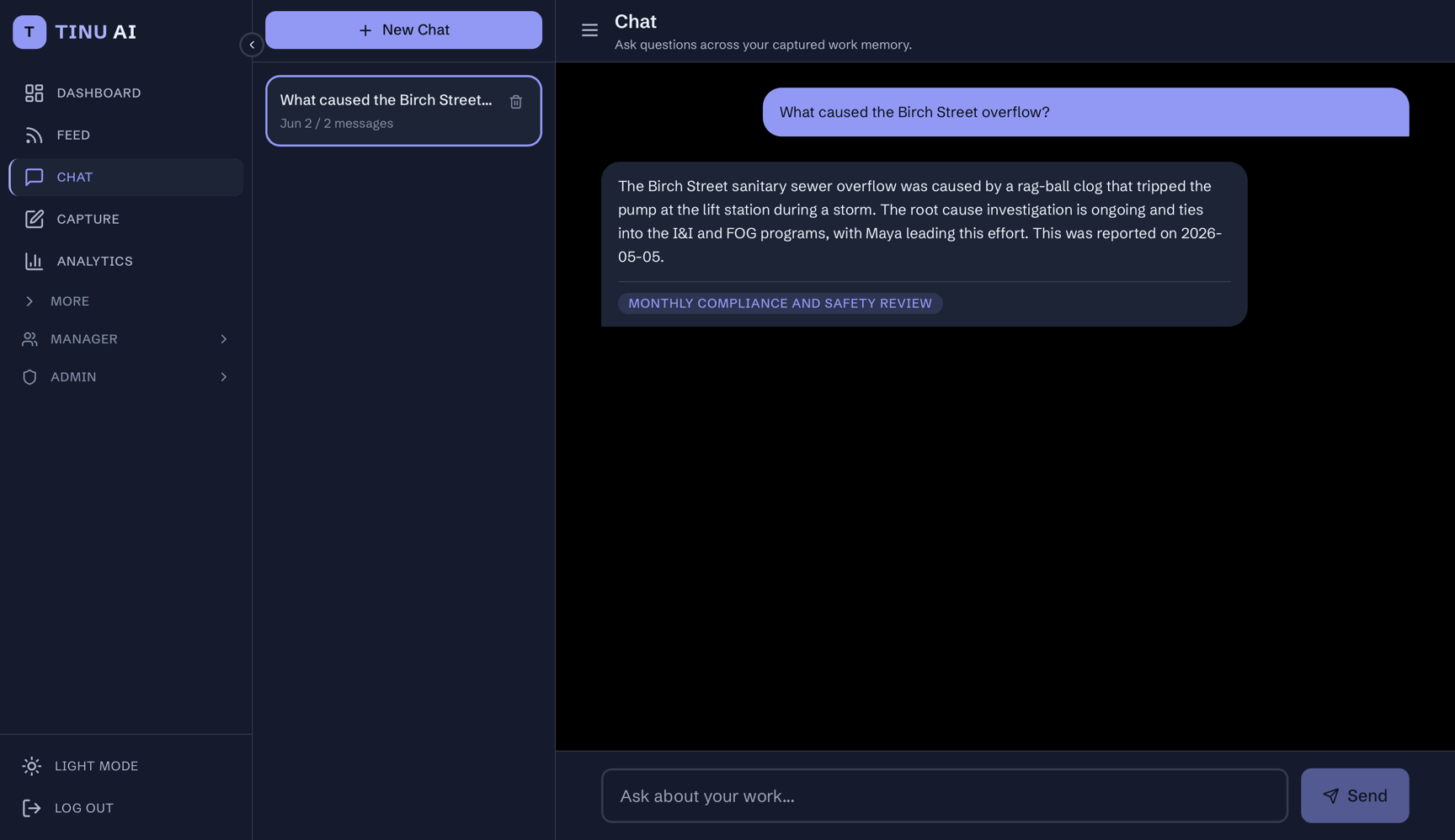
Hold the consent-decree schedule and the budget, with the context that usually retires.
- The digester-rehab consent-decree milestone has zero schedule float against a 30-week long-lead mixing part, now the top tracked risk.
- The Birch Street sanitary-sewer overflow root-caused to a rag-ball plus a fouled backup float, now fixed with a direct-page alarm and a budgeted comminutor.
- Filter-backwash optimization cut water use ~15% with no turbidity penalty, while the reservoir sits at 62% in a conservation-vs-revenue bind.
More than search
Search assumes the knowledge is already written down. Tinu assumes it is not, and builds the layer that makes it usable anyway.
Structured handoffs on day one
When someone changes roles or leaves, Tinu builds a structured handoff packet from everything it has captured. Continuity stops depending on an exit interview that never quite happens.
Knowledge graph
See how decisions, people, and entities connect across the organization, instead of staring at a list of documents.
Built-in governance
Roles and visibility controls keep knowledge scoped to the right people. Your data is never shared across organizations.
Memory that grows when people leave
When someone leaves, their knowledge stays. An alumni seat keeps everything they captured searchable, so turnover stops draining what your organization knows.
Four steps to institutional memory
01
Connect existing tools
Pulls from chats, docs, meetings, and tickets. No one changes how they work.
02
Structure the memory
Conversations become decision records: who decided, why, and what else was on the table. Each one gets scored for completeness.
03
Fill gaps and retrieve
Tinu prompts people to fill thin context, then answers in Slack with citations.
04
Continuity compounds
Tinu builds structured handoffs when people change roles, and new hires ramp faster.
Why this keeps happening
01
Decisions lose their reasoning
A call made six months ago lives in an email chain, but the reasoning is gone. The owner moved on, and someone new makes the same call from scratch.
02
Context lives in people, not systems
Your plant manager knows why a procedure exists. Your ops lead remembers which vendor failed the last RFP. When they retire, decades of judgment leave with them.
03
The answer exists. Nobody finds it
It is in a Slack thread, an email chain, a drive folder, a spreadsheet named “final_v3.” Search will find the keyword. It will not tell you the reasoning. Tinu does.
Start with a pilot, not a leap of faith
Tinu is delivered through a guided rollout, not a self-serve sign-up. Your first 30 days prove the value before you commit to a full year.
We handle onboarding and set up your templates with you. If you decide to keep going, the pilot rolls straight into your annual plan.
Common questions
What is Tinu AI?
An institutional memory platform that captures the knowledge your team cannot afford to lose: decisions, rationale, context, and hard-won expertise. It pulls from the tools you already use and makes everything searchable across your organization.
Who is Tinu for?
Operations-heavy mid-market organizations like utilities, manufacturers, and industrial operators. The kind of place where critical judgment lives in a few people’s heads, and a single retirement or handoff can wipe out context the organization cannot easily rebuild.
How does it connect to our tools?
Tinu integrates with Slack, email, meeting tools, project management, and document systems. It works in the background, so no one has to change how they work.
How is this different from a wiki or search?
Wikis and search both assume the knowledge is already written down. Tinu assumes it is not. It captures from where work actually happens, scores whether each record is complete enough to rely on, and fills the gaps through short guided conversations.
Is our data secure?
Yes. Your data is scoped to your organization, controlled by role-based visibility, and never shared across tenants. SSO and SOC 2 are currently in progress.
What happens after I reach out?
Tinu is currently in early access. When you get in touch, we add you to the onboarding queue and reach out to scope a pilot that fits your team.
Stop losing what your people know.
Your team’s most valuable knowledge was never written down. Tinu captures it before it walks out the door.
Continue